Achilles Tendinitis: Symptoms, Treatment & Exercises
What we’ll cover
- What Is Achilles Tendinitis?
- Symptoms: How Do You Know If You Have Achilles Tendon Pain?
- Common signs of achilles tendon discomfort
- Tendinitis vs a tear or rupture
- What Causes Achilles Tendon Pain?
- How Is Achilles Tendon Pain Diagnosed?
- Achilles Tendinitis Treatment
- Load management and activity modification
- Physiotherapy treatment
- How long does recovery take?
- When to consider other options
- Best Exercises for a Sore Achilles Tendon
- What to Avoid With Achilles Tendon Pain
- Achilles Tendinitis Treatment at ME Physio in Malvern East
- Frequently Asked Questions
- How long does Achilles tendon pain take to heal?
- Is walking bad for a sore Achilles tendon?
- Will Achilles tendon pain go away on its own?
- Should I stretch or rest an inflamed Achilles tendon?
- Is tendinitis the same as tendinopathy?
- What can be mistaken for Achilles tendonitis?
- Should I massage my Achilles tendon if it hurts?
- What is the quickest way to get rid of Achilles tendonitis?
- References
Ever woken up with your achilles tendon in pain, or felt a tight, achy heel when you head out for your morning walk? You’re far from alone. Achilles tendinitis is an overuse problem where the tendon connecting your calf muscles to your heel gets irritated and sore. The good news is that most cases settle well with the right amount of load, the right exercises and a bit of patience. Here’s what to look out for, what’s likely causing it, how it’s treated and when it’s time to see a physio.
What Is Achilles Tendinitis?
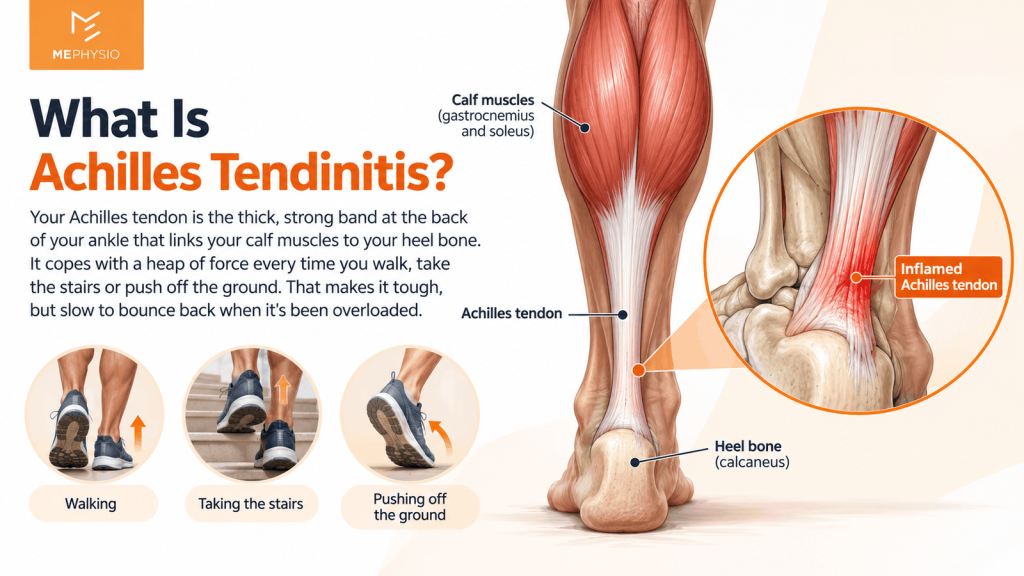
Your Achilles tendon is the thick, strong band at the back of your ankle that links your calf muscles to your heel bone. It copes with a heap of force every time you walk, take the stairs or push off the ground. That makes it tough, but slow to bounce back when it’s been overloaded.
You’ll often hear physios and doctors use the word tendinopathy instead of tendinitis. That’s because research shows the problem is usually about how the tendon handles load, rather than simple inflammation. Most people (and most Google searches) use the two terms interchangeably, so don’t be thrown if you hear both.
There are two main types:
- Midportion: pain and thickening in the tendon roughly 2 to 6 cm above the heel bone.
- Insertional: pain right where the tendon attaches to the heel, sometimes with a bony bump. It tends to flare with compression, like deep calf stretches or shoes with a stiff heel.
Symptoms: How Do You Know If You Have Achilles Tendon Pain?
Common signs of achilles tendon discomfort
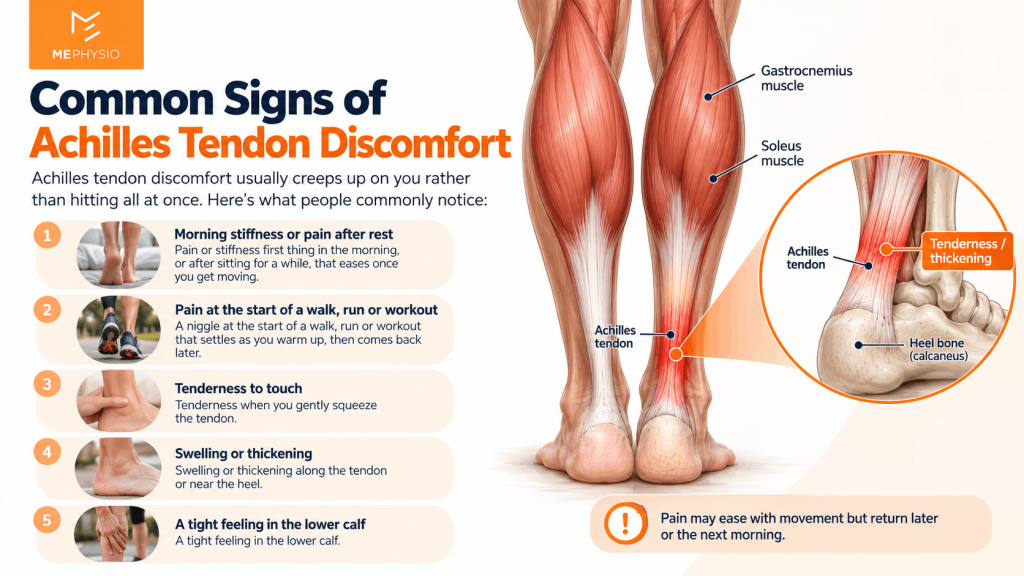
Achilles tendon discomfort usually creeps up on you rather than hitting all at once. Here’s what people commonly notice:
- Pain or stiffness first thing in the morning, or after sitting for a while, that eases once you get moving
- A niggle at the start of a walk, run or workout that settles as you warm up, then comes back later
- Tenderness when you gently squeeze the tendon
- Swelling or thickening along the tendon or near the heel
- A tight feeling in the lower calf
If you’ve got an achilles tendon in pain that eases with movement but returns at night or the next morning, that’s a classic pattern.
Tendinitis vs a tear or rupture
A tear is a different story and needs prompt attention. Get seen urgently by a GP, emergency department or physio if you:
- Felt a sudden snap, pop or a sensation of being kicked in the back of the ankle
- Have significant swelling or bruising around the tendon
- Can’t rise onto your toes on the sore leg
- Can’t walk normally or put weight through your foot
What Causes Achilles Tendon Pain?
The tendon gets sore when the load on it outpaces its ability to adapt. Common triggers include:
- A sudden jump in activity, like longer walks, hills, running or getting back into sport after a break
- Weak or tight calf muscles that aren’t sharing the load
- Worn-out shoes, or a sudden change in footwear
- Hard or uneven training surfaces
- Foot posture, such as flat feet or high arches, for some people
- Certain medications, including fluoroquinolone antibiotics and repeated corticosteroid injections, which are linked to tendon problems
Age plays a part too. Tendons get less forgiving over time, and a really common story in older adults is a long stretch of low activity followed by a keen return, like joining a new walking group or exercise class. An achilles tendon in pain after a sudden change like that is often a sign it needs more time to build up to the new demand.
How Is Achilles Tendon Pain Diagnosed?
Your physio will ask about your symptoms, activity levels and any recent changes, then examine the tendon. That usually means pressing or pinching along it to find the tender spot, checking your calf strength and flexibility, and seeing how it copes with single-leg calf raises or hopping. Specific tests can also help rule out a tear.
Not every sore heel or calf is the Achilles. Plantar fasciitis, bursitis behind the heel, a calf strain and irritation of the heel bone can all feel similar. That’s why it’s worth getting a proper assessment, and why persistent achilles tendon discomfort shouldn’t be left to guesswork.
You won’t always need an ultrasound or MRI. Imaging can help if the diagnosis isn’t clear, if things aren’t improving as expected, or if a tear is suspected.
Achilles Tendinitis Treatment
The aim is to calm the tendon down first, then gradually rebuild its ability to handle load.
Load management and activity modification
Complete rest is rarely the answer. Instead, ease back on the things that clearly aggravate it, like hill running, sprinting and jumping, and swap in lower-impact options such as swimming or cycling. Walking is usually fine within limits. A handy rule of thumb is that mild discomfort, up to about 3 or 4 out of 10, that settles within 24 hours is okay. If it’s sharp, or worse the next morning, you’ve done too much.
Physiotherapy treatment
For most people with an achilles tendon in pain, a progressive loading program is the cornerstone of treatment. Your physio will tailor the exercises to your tendon type, current strength and goals. Treatment may also include:
- Soft tissue work and mobility techniques for the calf
- Footwear advice, and a heel lift or orthotics in some cases
- Strengthening for the calf, hips and glutes so the whole leg shares the load
- A clear plan for getting back to walking, running or sport
How long does recovery take?
Tendons adapt slowly, so patience really does pay off. Plenty of people notice a difference within around 6 to 12 weeks of consistent loading, but full recovery commonly takes three to six months, and sometimes longer if it’s been brewing for a while. Sticking with your program even after the pain settles is the best way to stop it coming back.
When to consider other options
If you’re not progressing despite a well-run rehab program, it’s worth chatting with your GP or a specialist about other options. Shockwave therapy is sometimes used for stubborn cases. Corticosteroid injections are generally approached with caution around the Achilles because of the risk to the tendon, and surgery is rarely needed, usually only after several months of solid conservative care.
Best Exercises for a Sore Achilles Tendon
Gradually loading the tendon is one of the best-supported treatments. The exercises below are common examples, but the right starting point depends on your tendon and history, so it’s worth getting assessed first.
- Isometric calf hold. Stand with your feet hip-width apart and rise onto your toes, holding for about 30 to 45 seconds. Repeat three to five times. These holds are often used early on when the tendon is very irritable.
- Double-leg calf raises. Rise up slowly over three seconds, then lower over three seconds. Aim for three sets of 10 to 15 reps.
- Single-leg calf raises. Once double-leg raises feel comfortable, have a go on one leg, holding a wall or bench for balance. Try both a straight-knee and a bent-knee version to load different parts of the calf.
- Heavy slow resistance. Add weight with a backpack, dumbbells or a calf raise machine, and do slow reps for three sets, gradually lowering the reps as the weight goes up. Two to three sessions a week, with rest days in between, is typical.
If you’ve got insertional pain, keep your heel on flat ground rather than dropping it below the edge of a step, as that can irritate the tendon.
Take it steady. A little achilles tendon discomfort during exercise is often fine, but stop and modify things if the pain is sharp, if it lingers or is worse the next morning, or if swelling increases.
What to Avoid With Achilles Tendon Pain
- Complete rest. Too much rest weakens the tendon and makes it less able to cope when you return to activity.
- Aggressive stretching. Deep or repeated calf stretches can compress and irritate the tendon, especially with insertional pain.
- Rushing back to running. Build up gradually, and only once you can do single-leg calf raises comfortably.
- Pushing through sharp pain. Some discomfort is fine, but sharp or worsening pain is your cue to back off.
- Unsupportive footwear. Worn-out shoes, thin flat soles and shoes with a stiff heel that digs into the back of your heel can all make things worse.
Achilles Tendinitis Treatment at ME Physio in Malvern East
At ME Physio, our team works with people of all ages, including older adults who want to stay active and keep doing what they love. We’ll assess your tendon, explain what’s going on in plain English, and build a loading program that fits your lifestyle. Where it makes sense, we can back this up with strength and conditioning work, and our hydrotherapy services can offer a gentler way to keep moving.
If you’ve got an achilles tendon in pain that hasn’t settled after a couple of weeks, or you’re not sure whether it’s tendinitis or something else, book in for an assessment at our Malvern East or Caulfield South clinic. Give us a call on (03) 9571 6888 or book through our website, and we’ll help you get back to moving comfortably, without any recurring achilles tendon discomfort.
Frequently Asked Questions
How long does Achilles tendon pain take to heal?
Many people notice improvement within about 6 to 12 weeks of consistent loading, but full recovery often takes three to six months. It depends on how long you’ve had it and how well the load is managed.
Is walking bad for a sore Achilles tendon?
Usually not. Walking within a comfortable range is generally fine and often helpful. Cut back on distance, hills and pace if it causes sharp pain or leaves the tendon worse the next day.
Will Achilles tendon pain go away on its own?
Mild cases can settle with a sensible reduction in load. If it lasts more than a couple of weeks, keeps coming back or is getting worse, it’s best to get it checked.
Should I stretch or rest an inflamed Achilles tendon?
Neither on its own. Gentle movement and progressive strengthening usually work better than complete rest or aggressive stretching.
Is tendinitis the same as tendinopathy?
Not quite. Tendinopathy is the broader term for a painful tendon that’s struggling to cope with load, and it’s the one most clinicians prefer now. Tendinitis is the older term and is still widely used.
What can be mistaken for Achilles tendonitis?
Plantar fasciitis, bursitis behind the heel, a calf strain and irritation of the heel bone can all cause similar pain around the heel and lower calf. A partial Achilles tear can also be mistaken for tendinitis. A physio can examine the tendon and nearby structures to work out which one you’re dealing with.
Should I massage my Achilles tendon if it hurts?
Gentle massage of the calf muscles can ease tightness and make movement more comfortable. Avoid firm or deep pressure directly on a sore, thickened tendon, as it can aggravate symptoms. Massage works best as an add-on to a progressive strengthening program rather than a treatment on its own.
What is the quickest way to get rid of Achilles tendonitis?
There’s no instant fix, because tendons adapt slowly to load. The most reliable route is to ease back on aggravating activities early, start a progressive calf strengthening program, and build up gradually. Getting assessed early helps you start the right exercises for your tendon type and avoid setbacks.
References
- https://mephysio.com.au/blog/overuse-injuries-how-to-prevent-an-overuse-injury/ | Overuse injuries: How to prevent an overuse injury | 12 February 2026 | Jason Lee, ME Physio
- https://mephysio.com.au/blog/can-a-physiotherapist-help-with-plantar-fasciitis/ | Can a physiotherapist help with plantar fasciitis? | 12 February 2026 | Jason Lee, ME Physio
- https://mephysio.com.au/blog/training-principles/ | Training Principles: Peak Performance Without Injury | 18 September 2026 | Jason Lee, ME Physio
- https://mephysio.com.au/blog/physio-strengthening-exercises/ | Physio Strengthening Exercises for Injury Recovery | 18 September 2026 | Jason Lee, ME Physio
- https://www.healthdirect.gov.au/achilles-tendon | Achilles tendon injuries | Last reviewed May 2025 | Healthdirect Australia
- https://doi.org/10.31128/AJGP-07-20-5506 | The Achilles tendon: Management of acute and chronic conditions, Australian Journal of General Practice 49(11) | November 2020 | Andrew Touzell
- https://doi.org/10.2519/jospt.2024.0302 | Achilles Pain, Stiffness, and Muscle Power Deficits: Midportion Achilles Tendinopathy Revision 2024, Journal of Orthopaedic & Sports Physical Therapy | 2024 | Ruth L. Chimenti, Christopher Neville, Jeff Houck, Tyler Cuddeford, Dominic Carreira, RobRoy L. Martin
- https://doi.org/10.1177/0363546515584760 | Heavy Slow Resistance Versus Eccentric Training as Treatment for Achilles Tendinopathy: A Randomized Controlled Trial, The American Journal of Sports Medicine 43(7): 1704-1711 | July 2015 | Rikke Beyer, Mads Kongsgaard, Birgitte Hougs Kjaer, Tommy Ohlenschlaeger, Michael Kjaer, S. Peter Magnusson